
The Role of CAD/CAM and 3D Printing in Modern Dental Restorations
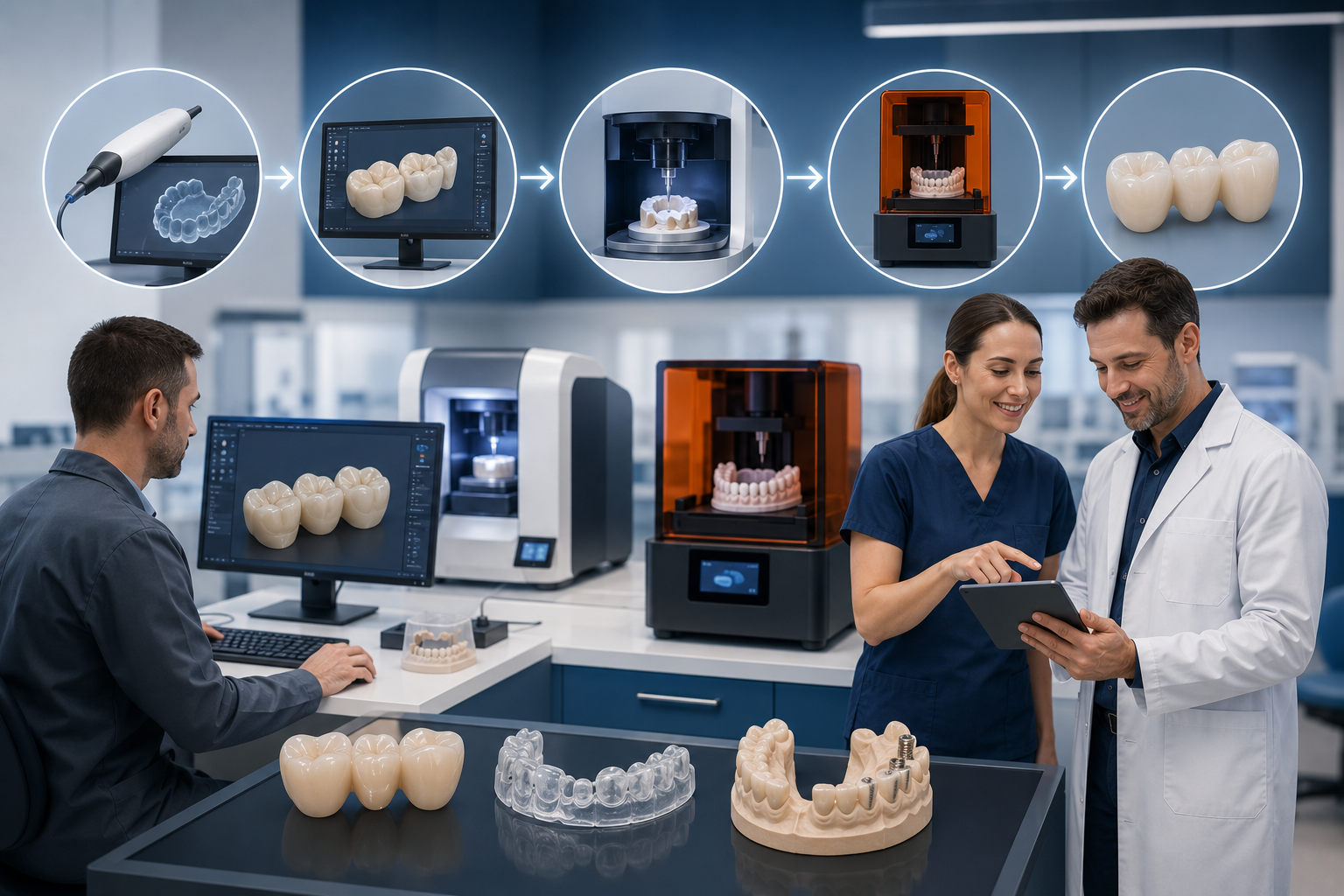
If you stepped into a top-tier dental laboratory in 2026 and looked around, you would not see what you would have seen even a decade ago. The wax pots and casting machines that defined the profession for a century have largely been replaced by computer workstations, five-axis milling units, and high-resolution 3D printers running quietly in temperature-controlled rooms. The technicians are still craftsmen — that has not changed — but their primary tools are software, scanners, and digital fabrication equipment that produces restorations to tolerances the analog process simply could not match.
This is the result of two technologies that, taken together, have transformed restorative dentistry: CAD/CAM and 3D printing. Both are now standard at any modern dental lab worth working with, and both are responsible for the dramatic improvements in fit, turnaround, and predictability that practices have come to expect. For dentists who want to understand how their cases are actually being made — and why a digital lab can deliver in three days what a traditional lab took ten days to produce — this article is the technical explanation, written for clinicians.
A Brief History of How Restorations Used to Be Made
To appreciate the change, it helps to remember the analog process. A traditional crown started as a physical impression of the prep, was poured into a stone model, and was waxed up by hand on the master die. The wax pattern was invested in a casting ring, the wax was burned out, and molten metal or pressed ceramic was forced into the resulting cavity. The casting was finished by hand, layered with porcelain, glazed, and polished. Every step depended on the technician's skill, the precision of the model, and the consistency of materials and equipment.
This process produced excellent dentistry when everything went well. It also had multiple compounding sources of error: impression distortion, model wear, wax shrinkage, casting porosity, porcelain firing variability, and a half-dozen smaller variables that could each push the final restoration a few microns off the prep. A skilled technician could produce a beautiful crown, but the consistency from case to case depended on factors that were difficult to control.
CAD/CAM and 3D printing did not just speed up this process. They replaced large parts of it with digital fabrication that operates on entirely different principles — digital files, computer-controlled cutting, and additive layer-by-layer manufacturing. The shift is comparable in magnitude to the transition from carriage building to automotive manufacturing in the early 20th century.
What CAD/CAM Means in Dentistry
CAD/CAM stands for Computer-Aided Design and Computer-Aided Manufacturing. In dentistry, the workflow is straightforward to describe even though the underlying technology is sophisticated.
The CAD side begins with a digital scan of the prep. The scan can come from an intraoral scanner used chairside or from a desktop scanner used by the lab to digitize a physical impression or model. The CAD technician opens the scan in dental design software, identifies the prep, marks the margin, and builds a virtual restoration on the digital model. The software helps with contact verification, occlusion analysis, minimum thickness checks, and contour design. The output is a precise 3D file describing exactly what the final restoration should look like.
The CAM side takes that file and produces the physical restoration. For most cases, this means subtractive manufacturing — milling. A puck of material is loaded into a CNC milling unit, the file is sent to the mill, and the restoration is cut from the puck using diamond burs and ceramic-cutting tools. Five-axis milling, which is the standard for any modern dental lab, allows the cutting head to approach the puck from any angle, producing complex undercuts, internal fits, and detailed occlusal anatomy in a single pass.
The precision of modern dental milling is roughly 25 to 50 microns. To put that in perspective, a human hair is about 70 microns thick. A well-milled crown fits the prep with a marginal accuracy that is essentially imperceptible to clinical inspection and well within the tolerance for cement film thickness. This is a level of consistency that hand fabrication, even in the most skilled hands, struggled to achieve case after case.
The Materials Revolution
CAD/CAM did not just change how restorations are made. It enabled materials that simply could not be used in the analog process. Modern dental milling works with a portfolio of materials that did not exist, or were not commercially viable, twenty years ago.
Zirconia is the most common. Modern multilayered zirconia provides excellent strength, biocompatibility, and a surprisingly natural appearance, especially in the latest high-translucency formulations. It can be milled in monolithic form for posterior crowns, layered with porcelain for high-aesthetic anteriors, and used for everything from custom abutments to long-span bridges and full-arch implant prosthetics.
Lithium disilicate is the workhorse for high-aesthetic single units. Milled from pre-shaded blocks and crystallized in a furnace cycle, lithium disilicate provides the optical depth and color characterization that anterior aesthetics demand, with strength values that have made it suitable for posterior molars in many indications.
Hybrid ceramics, resin-ceramic composite blocks, and PMMA are the materials behind chairside CAD/CAM, long-term provisionals, and try-in restorations. PMMA provisionals milled to the same precision as the final restoration give the patient a comfortable temporary, allow soft tissue to heal in the exact contour the final crown will occupy, and provide the dentist with an aesthetic preview before final fabrication.
Titanium milling is the technology behind custom implant abutments. Where stock abutments have to compromise on emergence profile, contour, and angulation, a milled titanium custom abutment is shaped specifically for the patient's tissue, the planned restoration, and the implant connection. The clinical advantage in soft tissue management and final aesthetics is significant, especially in the anterior zone.
Each of these materials is matched to specific clinical indications, and a strong digital lab will help guide the material selection conversation rather than defaulting to whatever the lab finds easiest to mill. The right material for a posterior crown is rarely the right material for an anterior veneer. A capable lab works through that decision case by case.
What 3D Printing Adds to the Workflow
3D printing — properly called additive manufacturing — is the second pillar of modern dental fabrication. Where milling cuts material away from a puck, 3D printing builds an object up layer by layer from a liquid resin or powder. The two technologies are complementary, not competitive. Each excels at different things.
3D printing has become the standard for several specific dental applications.
Surgical guides are the most common. A high-resolution dental printer can produce a full-arch, fully sleeved surgical guide in a few hours, with internal accuracy fine enough to guide implant placement to within tenths of a millimeter of the planned position. The same workflow that produces the guide also produces the working model the case is planned on, so everything from planning to surgery operates from a single coherent digital reference.
Working models for crown-and-bridge cases are increasingly printed rather than poured. A printed model is dimensionally stable, does not wear, can be reproduced from the same file if it is damaged, and integrates directly with the digital case file. Stone models still have a role in some indications, but for the majority of routine work, printed models have proven faster, more accurate, and more durable.
Custom trays for analog impressions are produced on the printer in under an hour. Denture try-ins, including teeth set to the planned occlusion, can be printed and adjusted multiple times during the case at very low marginal cost. Occlusal splints, night guards, and orthodontic appliances are all standard 3D printing applications now, and the materials available for permanent printed restorations are advancing rapidly.
The combination of milling and printing in a single lab is what defines a fully digital workflow. Cases that benefit from milling get milled. Cases that benefit from printing get printed. The lab does not have to compromise on one technology because it lacks the other.
Accuracy, Fit, and What That Means at the Seat Appointment
The clinical implication of CAD/CAM and 3D printing is felt at the seat appointment. A well-designed, well-milled crown should drop in, find its contacts, and require minor occlusal refinement at most. The five to fifteen minutes of grinding, repolishing, and re-checking that used to be standard in the analog era simply does not happen at the same rate in a digital workflow.
For implant cases the impact is even more dramatic. A custom abutment milled from a digital library aligns with the implant connection at a precision the analog process cannot match. Screw access channels land exactly where they were planned. Multi-unit cases that used to require chairside adjustment to reach passive fit now seat first time across all units in the majority of cases.
This first-time-fit advantage is not theoretical. Across well-run digital labs, first-time-fit rates of 95% or higher are routinely measured and reported. In analog workflows, similar measurements typically come in 10 to 20 percentage points lower. That gap, repeated across hundreds of cases per year, is the difference between a smooth restorative schedule and a schedule constantly disrupted by adjustment time and remakes.
The Patient Experience Connection
It is easy to talk about CAD/CAM and 3D printing as if they were technical considerations the patient does not see. They are not. The patient feels the difference at every stage.
Intraoral scanning is more comfortable than impression material. Same-visit provisional fabrication, when paired with chairside milling, can deliver a final restoration in a single appointment in some cases. Better-fitting crowns and bridges seat faster, requiring less chairside adjustment time. Aesthetic restorations milled to a precise digital design and characterized by a skilled technician deliver a more natural appearance than was easily achievable in the analog era. Surgical guides allow implant cases to be completed with minimal flap surgery, faster procedures, and better predictability. Each of these is a small improvement on its own. Together, they describe a restorative experience that simply was not available to the average dental patient ten years ago.
Patients notice, and they tell their friends. The practices that have embraced digital fabrication tend to grow faster, retain patients longer, and convert more case acceptance — not because the dentistry is dramatically different but because the experience around it has been quietly transformed.
What the Next Few Years Will Look Like
Dental fabrication technology is not done evolving. Several developments already moving from research labs into commercial use will likely change the landscape further over the next three to five years.
Permanent 3D printed restorations are advancing rapidly. Material formulations are now achieving the strength, wear resistance, and aesthetics needed for definitive crown-and-bridge applications, particularly in posterior single units and certain implant indications. As these materials mature, the line between printed and milled permanent restorations will continue to blur.
AI-assisted CAD design is reducing the time required to design routine cases by a meaningful margin. The technician's clinical judgment remains central, but the software can now propose initial designs that are 80 to 90% complete, leaving the technician to refine rather than build from scratch.
Real-time chairside-to-lab integration is improving. Practices using compatible scanners can now share scans with the lab in real time, get design feedback while the patient is still numb, and in some cases approve the case before the patient leaves the operatory.
Custom titanium and chromium-cobalt implant frameworks are increasingly milled rather than cast, with better fit, faster turnaround, and lower failure rates. Full-arch fixed implant prosthetics, in particular, have benefited enormously from digital fabrication.
The pace of development is fast, and the labs that invest in keeping their technology current will continue to widen the gap between modern digital production and the legacy analog model.
A Practice Built on the Right Technology Partner
CAD/CAM and 3D printing are not magic. They are precision tools that, in the right hands, produce restorations that fit, function, and look the way restorative dentistry has always aspired to deliver. The difference between a lab that uses these tools well and a lab that uses them as a marketing claim is enormous, and it is felt every day in the practice that has chosen its lab partner well.
For dentists building a restorative practice in the United States in 2026, the question is no longer whether to engage with digital fabrication. It is which lab to partner with, and how quickly the practice can build its workflow around the level of precision, predictability, and turnaround that modern digital labs are now delivering.
Built for Precision, Driven by Innovation
PROCERAM Dental Digital Lab has invested in the technology that makes modern restorative dentistry possible. Our facility is built around advanced five-axis milling units, high-resolution 3D printers, and a CAD design team that treats every case as an opportunity to deliver a restoration that fits the first time and looks like it belongs in the patient's mouth. Three decades of experience, fully digital end-to-end, located in Draper, Utah — built to support practices nationwide.
If you are ready to see what modern CAD/CAM and 3D printing can do for your cases, your schedule, and your patients, we should talk.
Contact PROCERAM Dental Digital Lab today: Phone: +1 (385) 425-8770 Email: Office@ProceramDentalLab.com Web: www.ProceramDentalLab.com Located in Draper, Utah — serving dentists nationwide.
